
Bestiary
Blood Dungeon Enemies: Behavior and Survival Guide
Blood Dungeon Enemies guide with confirmed behavior groups, named-source boundaries, survival responses, boss evidence, and living data table for verification.
Official video
Video ID verified from the Messhof game page; playback is served by YouTube.
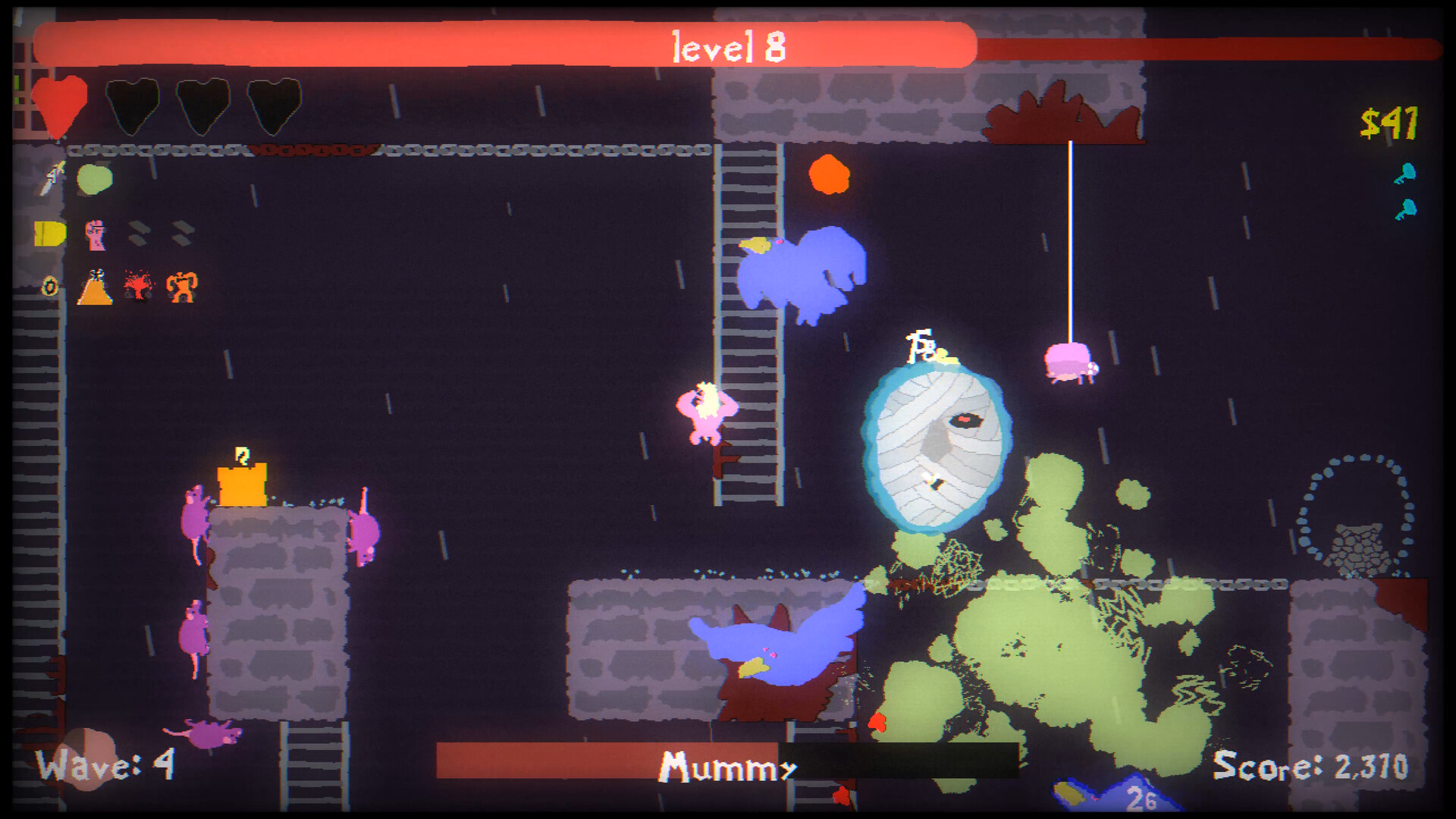
Messhof confirms more than 100 enemy types in the full game. Official copy mentions bats, centaurs, and exploding eyeballs, but a complete named bestiary still requires in-game verification.
| Platform | Status | Confirmed features | Data source |
|---|---|---|---|
| Flying through walls | Confirmed behavior group | Do not treat a wall as a permanent separation tool | Steam store ↗ |
| Walking on surfaces | Confirmed behavior group | Use changes in elevation to keep an exit route | Steam store ↗ |
| Sticking to surfaces | Confirmed behavior group | Observe the next landing before committing to a loop | Steam store ↗ |
| Bouncing on surfaces | Confirmed behavior group | Preserve space around landings; exact damage is TBD | Steam store ↗ |
| Wyrm / Bone Snake | Names visible in achievements | Not a complete roster or arena-assignment table | Steam Achievements ↗ |
Confirmed Behavior Table
The table is intentionally a behavior index rather than a fictional full bestiary. Steam confirms more than 100 enemy types and the four behavior families; it does not publish a one-to-one map from every name to every movement rule. Filter the table by the route problem you are seeing, then use the source link before treating an exact identity or statistic as settled.
The named examples in official product copy are bats, centaurs, and exploding eyeballs. The achievement page also makes Wyrm and Bone Snake visible as names. Neither source supports assigning all of their health, damage, spawn timing, or arena locations, so those cells are not invented here.
Enemies do not all obey the same platform rules. Some fly through walls, while others walk, stick, or bounce on surfaces. That means a route that is safe against one group can fail when a different movement type joins the wave.
Counterplay Framework
Use behavior rather than appearance as the first classification:
- Wall-crossing enemies: prioritize distance and timing over using terrain as a permanent barrier.
- Surface-bound enemies: use changes in elevation and gaps to control how quickly they can reach you.
- Bouncing or explosive threats: preserve extra room around landing and detonation zones.
- Mixed groups: identify which enemy removes your safest route and deal with that pressure first.
This framework is deliberately phrased as a survival habit, not as a hidden-stat guide. A wall-crossing threat makes a wall less reliable, while a surface-bound threat changes how much time an elevation shift may buy; that is all the official behavior language lets this page say with confidence. Keep an exit route and learn how the active group changes it before calling a target priority mandatory.
When a group first breaks your loop, record what happened in visible terms: the threat crossed a wall, reached a landing, or altered the path you planned to use. This produces a testable note without claiming an unverified name, damage value, or wave table. It also gives the page a clean future update path when a direct gameplay sample or official listing establishes the missing identity.
Boss and Achievement Evidence
Steam’s official achievements distinguish a first boss from a final boss in Catacombs and list similar checkpoint language for later arena progression. They also show Wyrm and Bone Snake as achievement-visible names. This is evidence that boss checkpoints matter to the progression path, not proof of a complete boss count, move set, or arena mapping.
Do not turn an achievement title into a combat guide without a matching release-build observation. Exact boss timing, health, behavior, and reward rules remain TBD. The walkthrough uses the same conservative boundary: it can show confirmed checkpoint names and still refuse to invent room-by-room instructions.
Verification Status
This bestiary expands only as evidence improves. Enemy names, exact health, damage, spawn timing, and arena-specific waves should be added only after direct gameplay capture or an official source confirms them.
For now, a useful player-facing loop is to classify the movement problem, protect an exit, and then test one route adjustment at a time. That approach remains helpful across the verified enemy-scale fact—more than 100 types—without pretending that an incomplete public roster is complete. Every new row should keep its source link, last-check date, and a clear TBD cell wherever the source is silent.